

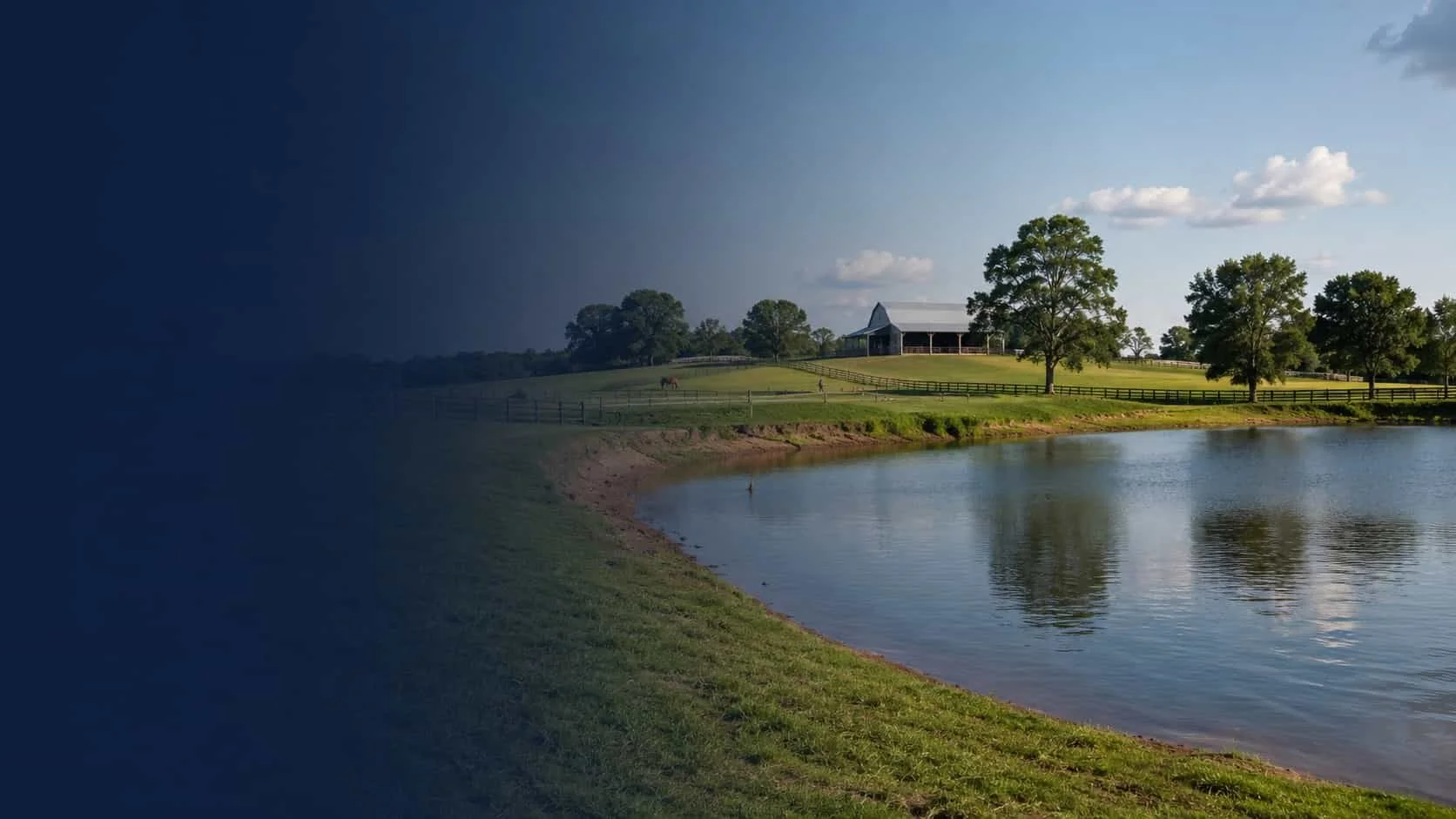
Big Land, Farms & Ranches Lake Pond Management
Livestock, Irrigation, or Both — the Pond Still Has to Work.
Pond Lake And Stormwater Management Services.
We help landowners keep ponds functional, banks stable, water usable, and runoff problems from turning into expensive surprises.
Working Land, Working Water
A farm pond is rarely just a pond. It may support livestock, irrigation, fishing, wildlife, fire protection, drainage, or the general sanity of whoever has to look at it every morning.
Across the North Carolina Piedmont, pond problems usually come from a familiar mix: Carolina clay, heavy spring runoff, fertilizer movement, livestock access, sediment, heat, and time. That combination can reduce pond depth, feed algae, erode banks, clog outfalls, and make a useful waterbody less useful every season.
We work with landowners practically. We look at how the pond actually functions on the property, not just how it looks from the driveway. Farm ponds have a way of waiting until you need them before acting weird. Consider our proactive approach.
Sediment reduces pond capacity and can make irrigation or livestock water access less reliable.
Livestock access points damage banks faster than anything else if not managed.
Agricultural runoff feeds algae and nuisance aquatic vegetation.
Poor circulation leads to low oxygen, fish stress, odor, and murky water.
Dams, spillways, banks, and outlet structures need periodic review.
Multi-pond properties benefit from a mapped inventory and a priority list.

Pond, Lake, Fountain & Stormwater Services For Farms
We evaluate pond function first — water depth, access points, bank condition, inflow, outflow, aquatic vegetation, and visible sediment load — then build a plan around what the pond is for and what condition it's in.
Livestock & Irrigation Pond Service
Working ponds need different care than decorative ones. We focus on usability — water access, water quality during heat stress, and bank integrity around heavy-use areas.
- Pond condition assessments
- Water quality review
- Livestock access impact review
- Irrigation intake-area maintenance
- Capacity and depth observation
- Heat-stress season planning
Algae & Aquatic Vegetation Control
Agricultural runoff plus Carolina heat is an algae starter kit. We treat the cause alongside the bloom, with attention to livestock and irrigation use cases.
- Targeted algae treatments (livestock-safe where required)
- Aquatic weed management
- Vegetation control
- Source-side runoff planning
- Follow-up monitoring
- Seasonal treatment scheduling
Sediment, Banks & Dam Review
Banks, dams, spillways, and outlet structures are where serious problems quietly start. We look for the early signs.
- Sediment depth and capacity assessment
- Bank stabilization planning
- Dam visual inspection
- Spillway and outlet structure review
- Erosion control planning
- Repair prioritization
Aeration & Pond Health
Aeration improves oxygen, circulation, fish health, odor control, and water quality — especially in deeper farm ponds during summer.
- Aeration assessment and design
- System installation
- Maintenance and tuning
- Motor, cable, and float checks
- Fish-health observation
- Habitat consideration
Multi-Pond Inventory & Long-Term Planning
Working properties often have multiple ponds. We map them, prioritize them, and help you plan ahead so reactive repairs don't dictate the budget.
- Multi-pond mapping and condition tracking
- Maintenance recommendations with priorities
- Annual and seasonal planning
- Capital planning input
- Photo documentation
- Long-term improvement planning

Serving Large Land Tracts Across the North Carolina Piedmont
We plan service around Piedmont realities — Carolina clay, agricultural runoff, summer heat stress, livestock impact, and the working calendar of a real farm operation. We're comfortable with gates, rural access, and the way real properties actually work. Proudly serving Charlotte, Concord, Mooresville, Statesville, Hickory, Salisbury, Winston-Salem, High Point, Greensboro, Lake Norman, the Piedmont Triad, and Catawba Valley.

Farms & Large Land Properties Lake, Pond and Stormwater FAQ
What does farm pond management actually cover?
Pond condition assessment, water quality review, aquatic vegetation management, sediment and capacity planning, livestock-access impact review, irrigation support, bank and dam observation, and outlet structure review. The scope depends on what the pond actually does on your property.
How do I keep my pond usable for livestock?
Manage access points so banks don't erode, watch nutrient and waste loading, keep aquatic vegetation in check, and review water quality during heat stress periods. A pre-summer review usually pays off.
My irrigation pond is filling with sediment. What now?
Sediment in irrigation ponds reduces capacity, complicates pump intake, and gradually changes what the pond can deliver. Options include sediment removal planning, watershed-side erosion control, and intake-area dredging. We can assess depth and capacity and help you prioritize.
Why is my farm pond turning green?
Agricultural runoff (fertilizer, manure, organic load) + warm shallow water + sunlight + poor circulation = algae. Aeration helps. Source-side runoff management helps more. Treatment is the third lever, not the first.
Our dam looks like it's slumping. How worried should we be?
Worth a look. Dam slump, seepage, eroded toe areas, or unmanaged tree growth on a dam can all develop into serious problems. We can do a visual assessment and tell you whether it's a maintenance item, a coordinate-with-NC-DEQ item, or an engineer-needed item.
Can pond maintenance support fish health?
Yes. Fish health depends on oxygen, habitat, water depth, vegetation balance, and seasonal stress management. We're not a stocking service, but we can build a pond that holds healthy fish.
How do you handle multi-pond properties?
Map them, walk them, and prioritize. A working farm may have several ponds serving different functions. We build maintenance plans based on what each pond does for the property, not a one-size-fits-all template.
What's the most common preventable problem on farm ponds?
Bank erosion from livestock access. It quietly reduces pond capacity, increases sediment load, and creates downstream water quality issues. Managing access points is one of the highest-ROI maintenance investments on a working farm.
Do you serve farms across the Piedmont?
Yes. Charlotte, Concord, Mooresville, Statesville, Hickory, Salisbury, Winston-Salem, High Point, Greensboro, Lake Norman, the Piedmont Triad, and the Catawba Valley. We're comfortable with rural access, gates, livestock, and working land.
Do farm ponds need stormwater compliance review?
Sometimes — depends on size, construction history, and whether the property has permitted stormwater infrastructure. Pure agricultural ponds often don't fall under NC DEQ SCM regulations, but recently developed acreage with permitted basins may.